

The Workout Question: What Happened When Older Adults Took Resveratrol While They Trained

Chapter 1 of 4
The Question Every Training Season Raises
Picture a man of 66 who has decided, after years of good intentions, to start lifting. His doctor has said yes. A physiotherapist has shown him six simple moves. Twice a week, on Tuesday and Friday mornings, he walks to a small gym and works through them. On his kitchen shelf sits the resveratrol he has taken for two years.
Somewhere in his second week, he asks a reasonable question: does that capsule help my training, hold it back, or do nothing at all?
It sounds like the kind of question nobody could answer. In fact, several research teams have tried, with older adults, real training programmes, placebo groups and muscle biopsies. Their answers did not agree. That disagreement is the most useful part of the story, because it shows exactly what to look at before you draw a conclusion for yourself.
The trials did not simply say yes or no. They said: it depends on the dose, the programme, and which result you measure.
We go in order. First, what training actually changes in an older body, and why scientists started testing supplements alongside exercise. Then the 2013 Copenhagen trial, whose fitness result went the wrong way. Then two later trials that used higher doses and mixed walking with strength work, and reported better muscle and walking results than exercise alone. Finally, what all of this means if you train, including what has never been tested.
If you read our earlier article The Two-Year Window, about a long resveratrol trial in women after menopause, this one asks a different question: not what resveratrol does on its own, but what happens when it meets exercise.
Section 1
January, a New Programme, a Familiar Bottle
Our man of 66 is not unusual. Many people who take a longevity supplement also exercise, or plan to. And many start or restart a programme after 60, when they notice that stairs feel steeper or a suitcase heavier than it used to.
For them, the question is practical. They are not asking whether resveratrol is a substitute for exercise. It is not, and no serious researcher has claimed it is. They are asking whether the two work together, or whether one might get in the way of the other.
That second possibility is not fanciful. Exercise works partly through stress. A hard session briefly disturbs muscle cells, and the recovery from that disturbance is what makes them fitter. Anything that changes how cells respond to stress could, in principle, change the adaptation. That is the reason researchers test it, rather than assume it.

Older muscle still responds to training. The question in this article is whether a supplement changes how much.
Section 2
What 'Adaptation' Means
When scientists say a training programme “works”, they mean it produces adaptations: measurable changes in the body that make the next session easier. In the trials we cover, four kinds of change were measured. It helps to keep them apart, because a supplement can affect one and not another.
- Aerobic fitness. Usually measured as VO2max, the most oxygen your body can use during all-out effort. It is one of the strongest single markers of physical capacity as we age.
- Mitochondria in muscle. The structures inside muscle cells that turn fuel and oxygen into usable energy. Training tends to increase their number and activity. Researchers measure this with small muscle samples, called biopsies.
- Strength and power. How much force a muscle can produce, often measured at the knee, and how fast it can produce it.
- Walking and everyday function. Tests such as the six-minute walk, which counts how far you can walk at your own pace in six minutes, or gait speed.
The encouraging part comes first: older muscle still adapts. In the trials below, men and women in their sixties and seventies improved on several of these scorecards with a few months of training. That is true in the placebo groups too. The exercise did most of the work, in every trial. The supplement question is about the margin on top.
Section 3
Why Scientists Asked at All
The question became popular after a 2009 study in Germany. Thirty-nine young men trained for four weeks. Some took high doses of vitamin C (1,000 mg a day) and vitamin E (400 IU a day); others did not. Training improved insulin sensitivity, a marker of how well the body handles blood sugar, but only in the men who were not taking the vitamins.
The authors suggested that the short burst of oxidative stress during exercise acts as a signal for adaptation, and that very high doses of antioxidant vitamins might muffle it.
Two cautions before we go further. That study tested vitamins C and E, not resveratrol, in young men, not older adults. And it did not show that “antioxidants are bad”. It raised a question, and the question was then asked of other compounds, including resveratrol. Whether the answer carries over has to be tested compound by compound, dose by dose. That is what the next two chapters are about.
Chapter 1 · 3 questions
Test Your Longevity IQ: Chapter 1 Quick Quiz
Question 1
Which of these is NOT one of the training “scorecards” this chapter describes?
AAerobic fitness (VO2max)
BMitochondria in muscle
CStrength and walking
DHair growth
Reveal Answer
Correct Answer: D.
The four scorecards are aerobic fitness, mitochondria, strength and power, and walking. A supplement can affect one without affecting the others.
Question 2
Why do researchers test supplements alongside an exercise programme?
ABecause exercise produces measurable adaptations, and a compound might add to or blunt them
BBecause supplements replace exercise
CBecause exercise has no measurable effects
DBecause it is required by law
Reveal Answer
Correct Answer: A.
Exercise reliably changes fitness, muscle and function. Testing a compound alongside it shows whether the compound adds to those changes, blunts them, or does neither.
Question 3
What did the 2009 vitamin C and E study in young men find?
AThe vitamins doubled fitness
BTraining improved insulin sensitivity only in men who did not take the vitamins
CNo measurable effect on anything
DIt tested resveratrol
Reveal Answer
Correct Answer: B.
Insulin sensitivity improved with training only without the vitamins. It tested different compounds in young men, so it raised a question rather than answering it for resveratrol.
Chapter 2 of 4
Copenhagen, 2013: The Fitness Test
In 2013, a team at the University of Copenhagen published the first careful test of resveratrol alongside training in older people. They had expected good news. The animal research of the time suggested resveratrol might improve heart health and physical capacity, and they set out to see whether it would add to the benefits of exercise in men of retirement age.
The result went the other way on several measures. It is worth reading slowly, because it is often quoted in a single line, and the line usually leaves out what the same research programme found next.
Section 1
Twenty-Seven Men, Eight Weeks, One Dose
The trial recruited 27 healthy men with an average age of 65. All were physically inactive at the start. For eight weeks, every man did high-intensity exercise training. At random, 14 of them also took 250 mg of trans-resveratrol a day, and 13 took a placebo. Neither the men nor the researchers knew who was taking what.
Before and after the eight weeks, the team measured fitness on a bike, blood pressure, blood fats, and markers in muscle and blood vessel tissue.
Section 2
The Number That Moved the Wrong Way
Training raised aerobic fitness in both groups, as expected. But the increase in VO2max was 45% greater in the placebo group than in the resveratrol group. Mean arterial pressure, an average of the blood pressure across each heartbeat, fell by about 4.8 mmHg in the placebo group only.
Blood fats told a similar story. In the placebo group, training improved LDL cholesterol, the ratio of total to HDL cholesterol, and triglycerides. In the resveratrol group, those improvements did not appear. One marker of blood vessel health, VCAM-1, changed the same way in both groups.
The authors' conclusion was direct: exercise improved several cardiovascular measures in these older men, and resveratrol at this dose blunted those effects. That is the line most people remember.
Real study results · Copenhagen, 2013–2014
Eight weeks of training in men in their sixties: what changed with placebo and what changed with resveratrol
Healthy, inactive men aged about 60 to 72; 250 mg trans-resveratrol a day or placebo; both groups trained hard for 8 weeks. Direction of each published result.
Aerobic fitness (VO2max): rose in both groups; the rise was 45% greater with placebo.
Blood pressure (mean arterial): fell by about 4.8 mmHg with placebo only.
Blood fats (LDL, cholesterol ratio, triglycerides): improved with placebo; not with resveratrol.
Mitochondrial markers and leg endurance: rose with training (endurance about 1.2-fold); resveratrol added nothing and took nothing away.
Two muscle markers of oxidative stress and inflammation: improved with training; resveratrol blunted the improvement.
Resveratrol without training: no measurable metabolic improvement.
Sources: Gliemann et al., Journal of Physiology 2013 (27 men, reference 1); Olesen et al., Journal of Physiology 2014 (men aged 60–72, reference 2). The figure shows the direction of each reported result; amber = less improvement with resveratrol than with placebo, mint = no difference between groups, grey = resveratrol alone.
Section 3
Inside the Muscle
A year later, the same Copenhagen group published a second paper from their research programme, this time looking inside the muscle. Healthy, inactive men aged 60 to 72 took 250 mg of resveratrol or placebo for eight weeks, either with the same high-intensity training or without any training at all. Small muscle samples were taken before and after.
Training did what training does. Markers of mitochondrial activity rose by roughly a third to a half, and the time the men could keep up a one-legged knee exercise before exhaustion rose about 1.2-fold. On these measures, resveratrol made no significant difference, in either direction.
Two other markers did differ. Training reduced a measure of oxidative damage to muscle proteins by about 20% and a marker of inflammation by about 40%, and resveratrol blunted both of those improvements. And resveratrol taken without training produced no measurable metabolic improvement at all. The title of the paper summed it up: exercise training, but not resveratrol, improved the muscle of older men.
In Copenhagen, the training did the work. At 250 mg a day for eight weeks, resveratrol added nothing measurable, and on some markers it held the training back.
Section 4
What This Trial Can and Can't Tell You
These were careful, double-blind studies, published in a leading physiology journal. They deserve to be taken seriously. They also have clear limits, and the limits matter for the next chapter.
- Men only. No women took part.
- One modest dose. 250 mg a day. Later trials used two and four times as much.
- Eight weeks. Some adaptations, especially in strength and muscle size, take longer to show.
- One kind of training. High-intensity sessions, mostly aerobic. Strength training and walking programmes were not tested.
- Healthy starting point. The men were inactive but healthy, with plenty of room to improve on fitness and blood pressure.
So the honest summary of Copenhagen is narrow: in healthy, inactive men of about 65, 250 mg of resveratrol a day for eight weeks of hard training did not help, and on fitness, blood pressure, blood fats and two muscle markers, it was linked with smaller gains than placebo. It does not tell us what happens with a different dose, a different programme, women, or people who start with physical limitations.
The product behind this article

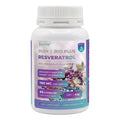
Resveratrol + Quercetin 700mg · 60 Capsules
Two capsules a day provide 1,000 mg of trans-resveratrol and 400 mg of quercetin. That is four times the Copenhagen dose, and the same resveratrol dose as the highest arm of the 2021 trial in Chapter 3. Chapter 4 explains plainly what has and has not been tested.
See Resveratrol + Quercetin →Or pass the Final Master Quiz below first: 4 out of 5 unlocks your reader reward.
Chapter 2 · 3 questions
Test Your Longevity IQ: Chapter 2 Quick Quiz
Question 1
How much resveratrol did the men in the 2013 Copenhagen trial take?
A50 mg a day
B250 mg a day
C1,000 mg a day
D5 g a day
Reveal Answer
Correct Answer: B.
They took 250 mg of trans-resveratrol a day for eight weeks while training. Later trials used 500 and 1,000 mg.
Question 2
What happened to aerobic fitness (VO2max)?
AIt rose more in the placebo group
BIt rose only with resveratrol
CIt fell in both groups
DIt was not measured
Reveal Answer
Correct Answer: A.
Fitness rose in both groups, but the increase was 45% greater with placebo than with resveratrol.
Question 3
What did the 2014 muscle-biopsy paper find for mitochondrial markers and leg endurance?
AResveratrol doubled them
BTraining raised them, and resveratrol made no significant difference
CThey fell with training
DThey were not measured
Reveal Answer
Correct Answer: B.
Training raised mitochondrial markers by roughly a third to a half, and endurance about 1.2-fold. Resveratrol neither added to nor reduced those gains, though it blunted two markers of oxidative stress and inflammation.
🔒 LOCKED: READER REWARD
There is a reader reward waiting at the end of this article.
Read the next two chapters closely. Score at least 4 out of 5 on the Final Master Quiz at the bottom of the page and you unlock a 12-week programme modelled on the newer trials, on one page: two sessions a week, simple moves, and a self-test log for weeks 0, 6 and 12.
Every answer is in the chapters you are reading…
[ Jump to the Final Master Quiz → ]Chapter 3 of 4
Twelve Weeks Later, a Different Answer
If the story ended in Copenhagen, the advice would be simple. It did not end there. Two later trials in the United States changed three things at once: they used higher doses, they ran for twelve weeks instead of eight, and they mixed walking or aerobic work with strength training. They also recruited women as well as men, and in one case people who already found everyday movement harder.
Their results pointed the other way on the measures they chose. Neither trial cancels Copenhagen. Together, they show why one study rarely settles a question like this.
Section 1
Thirty Older Adults, Strength and Walking
In 2017, a team at West Virginia University reported a trial in 30 adults aged 65 to 80: 12 men and 18 women. All of them completed 12 weeks of combined aerobic and resistance exercise. At random, they took either 500 mg of resveratrol a day or a placebo.
The researchers had hoped resveratrol would lower cardiovascular risk further than exercise alone. It did not. On that question, the result was neutral.
In the leg muscles, though, the picture was different. In the resveratrol group, knee-extensor peak torque rose 8%, average peak torque 14% and power 14% after training, while the placebo group, doing the same exercise, did not show significant gains on these measures. Muscle samples from the thigh showed that the average fibre size rose 45.3% and the number of nuclei in the fibres by about 20% in the resveratrol group. Measures of mitochondrial density and fatigue resistance also improved more than with exercise and placebo.
This is a small trial, with 15 or so people per group, and strength results in small groups can swing. But it was double-blind, it included women, and the direction of the result was the opposite of Copenhagen's fitness finding. The authors described it as a possible anabolic role, meaning a role in building muscle, which needed a larger trial to test.
Section 2
Sixty People, Two Doses, a Six-Minute Walk
In 2021, a team from the University of Alabama at Birmingham and the University of Florida published a pilot trial in 60 adults with an average age of about 72. Everyone had some limitation in physical function: walking, climbing stairs or getting up from a chair had become harder for them.
All 60 followed the same programme for 12 weeks: two supervised sessions a week of walking plus whole-body resistance training. At random, they took a placebo, 500 mg of resveratrol a day, or 1,000 mg a day.
The first aim was safety and practicality, and on both counts the trial passed. Side effects were similar across the three groups, 85% of participants took their capsules as planned, and 82% attended their sessions.
The most-watched result was the six-minute walk. After 12 weeks, participants walked on average 9.5 metres further with placebo, 22.9 metres further on 500 mg, and 33.1 metres further on 1,000 mg. In the placebo group the range of plausible values included zero; in both resveratrol groups it did not. Gait speed changed only slightly in every group, and those differences were too small to separate from chance.
Real study results · Harper et al., 2021
Six-minute walk: extra distance after 12 weeks of the same training, by daily dose
60 adults, average age about 72, with functional limitations. Everyone trained twice a week (walking + whole-body strength work). Average change from week 0 to week 12, adjusted for age and sex.
Exercise + placebo
+9.5 m
95% range −9.0 to +27.7 m (includes zero)
Exercise + 500 mg resveratrol a day
+22.9 m
95% range +4.2 to +41.6 m
Exercise + 1,000 mg resveratrol a day
+33.1 m
95% range +13.8 to +52.4 m
Source: Harper et al., Experimental Gerontology 2021 (reference 4). Pilot trial designed to test safety and feasibility, not to prove an effect. Bars start at 0 m.
Read this with care. A pilot trial is a rehearsal for a larger one, not designed to prove an effect, and the authors said so: a larger trial was needed to test the result properly. But a dose pattern, with the higher dose ahead of the lower one and both ahead of placebo, is the kind of signal that makes researchers want that larger trial.

Muscle fibres in cross-section. In the 2017 trial, fibre size was measured in thigh samples.
Section 3
Why the Answers Differ
Put the trials side by side and the disagreement starts to look less like a contradiction and more like a map. They differed in at least five ways:
- Dose. 250 mg in Copenhagen; 500 mg in West Virginia; 500 and 1,000 mg in Alabama.
- Programme. High-intensity, mostly aerobic training in Copenhagen; mixed aerobic or walking plus strength work in the later trials.
- Scorecard. Copenhagen's headline was aerobic fitness and blood pressure. The later trials' headlines were strength, muscle fibres and walking distance.
- People. Healthy inactive men in Copenhagen; men and women in West Virginia; people with functional limitations in Alabama.
- Duration. Eight weeks against twelve.
No single trial changed one thing at a time, so we cannot say which difference mattered most. What we can say is that “resveratrol blunts exercise” and “resveratrol boosts exercise” are both too simple. In these studies, the answer depended on what was measured, in whom and at what dose.
Reviews of the field reflect that. A 2024 systematic review of 10 randomised trials in older adults concluded that resveratrol combined with exercise improved exercise adaptation and muscle function in healthy older adults, and mobility measures in those with functional limitations. A broader review published in November 2026, covering trials of several polyphenols in adults over 55, was more cautious: in five completed trials, strength improved in two, function and balance improved in two of the three that measured them, effects on muscle mass were inconsistent, and the evidence was described as too small, varied and methodologically limited to support firm recommendations.
Both reviews are right about their own question. The trials are encouraging in places, and still too few and too small to settle the matter.
Chapter 3 · 3 questions
Test Your Longevity IQ: Chapter 3 Quick Quiz
Question 1
In the 2017 trial of adults aged 65–80 (500 mg a day, 12 weeks), what changed more with resveratrol than with placebo?
ABody weight only
BKnee strength, muscle fibre size and fatigue resistance
CNothing
DBlood pressure only
Reveal Answer
Correct Answer: B.
Knee-extensor torque and power rose with resveratrol but not significantly with placebo; fibre size and fatigue resistance also improved more. Cardiovascular risk was not reduced further.
Question 2
In the 2021 pilot, which group improved its six-minute walk the most?
APlacebo
B500 mg a day
C1,000 mg a day
DAll three were identical
Reveal Answer
Correct Answer: C.
Average gains were 9.5 m with placebo, 22.9 m on 500 mg and 33.1 m on 1,000 mg, all with the same twice-weekly training.
Question 3
Why should the 2021 result be read with care?
AIt was a small pilot, not designed to prove an effect
BIt was done in mice
CIt lasted one day
DIt had no placebo group
Reveal Answer
Correct Answer: A.
Its aims were safety and feasibility. The authors called for a larger trial to test the walking result properly.
Chapter 4 of 4
What This Means If You Train
Back to our man of 66 with his Tuesday and Friday sessions. What can the trials honestly tell him? More than nothing, and less than the confident claims he might read elsewhere. Here is how we would put it, in order of importance.
Section 1
Start With the Programme
In every trial in this article, the exercise did most of the work. Placebo groups gained fitness, mitochondria and endurance. The question was only ever about what a supplement might add on top.
The two later trials give a sensible template for the programme itself: about 12 weeks, two sessions a week, each combining walking with simple strength exercises for the legs, back and arms. That is achievable for most people, and it is the shape of the reader reward at the end of this article.
If you have a heart, joint or balance condition, or have not exercised for a long time, speak to your doctor before you start. A physiotherapist or trainer can adjust the moves to you.
Section 2
The Quercetin Trials, in Brief
Quercetin, the second compound in the product we discuss below, has its own small set of training trials. Two are worth knowing.
In a 2025 double-blind trial in Japan, 26 healthy older adults did six weeks of resistance training and took either 200 mg of quercetin glycosides a day or a placebo. Maximal knee-extensor force rose to about 115% of its starting value with quercetin, against about 105% with placebo. Muscle size did not change in either group; the authors linked the extra strength to the nervous system's control of the muscle, measured as faster firing of higher-threshold motor units.
Real study results · Nishikawa et al., 2025
Knee strength after 6 weeks of resistance training, with quercetin or placebo
26 healthy older adults; 200 mg quercetin glycosides a day or placebo. Maximal knee-extensor force after training, as a percentage of each group's starting value (100%).
Training + placebo
105.3%
Starting value = 100%; gain about 5 percentage points
Training + 200 mg quercetin glycosides a day
115.1%
Gain about 15 percentage points; muscle size unchanged in both groups
Source: Nishikawa et al., European Journal of Nutrition 2025 (reference 6). Bars start at 90% so the difference is visible; quercetin glycosides are a different form from the quercetin dihydrate in the product below.
A longer 2022 trial was less positive on size. 48 Japanese adults aged 50 to 74 completed 24 weeks of light resistance training three times a week, with 200 mg or 500 mg of quercetin glycosides or a placebo. Thigh muscle size and lean mass, the main outcomes, did not differ between groups. Muscle stiffness at rest was lower with both doses. Several of the authors work for Suntory Wellness, a Japanese drinks and supplements company.
One more detail matters. These trials used quercetin glycosides, a form bound to sugar molecules that is absorbed differently. The product below contains quercetin dihydrate. We do not transfer the glycoside results to it.
Section 3
What No Trial Has Tested
It is easy to blur what has been studied with what sounds plausible. So, plainly:
- No trial has tested resveratrol and quercetin together alongside a training programme. Each has been studied with training on its own, in different trials and in different forms.
- No trial has tested timing. Whether you take capsules in the morning, before a session or after it has not been compared in these studies.
- No trial has run longer than 24 weeks with quercetin, or 12 weeks with resveratrol and training in older adults.
- The 1,000 mg resveratrol result is a pilot. Promising, consistent in direction, and still waiting for a larger trial.
If you see a claim that goes further than this, it is going further than the evidence.
Section 4
Where Resveratrol + Quercetin Fits
Our Resveratrol + Quercetin 700mg provides, in two capsules a day, 1,000 mg of trans-resveratrol from Japanese knotweed (Polygonum cuspidatum) and 400 mg of quercetin dihydrate from the Japanese pagoda tree (Sophora japonica). A bottle of 60 capsules lasts 30 days.
The resveratrol dose is the same as the highest arm of the 2021 walking-and-strength pilot, and four times the dose used in Copenhagen. We cannot promise the trial results, and nobody honestly can: the pairing itself has not been tested with training, and the evidence for each compound is still small. What we can offer is the dose the more recent trial used, in a simple daily form.
It suits people over 50 who train, or are about to start, who want to follow the more recent research rather than wait for the final word, and who are comfortable judging the result over months rather than days. It is not for anyone who takes blood thinners or regular medication without first checking with their doctor, as the label states.

Two sessions a week for twelve weeks: the part of the routine the trials agree on most.
The product behind this article
Resveratrol + Quercetin 700mg · 60 Capsules
For readers who train or are starting: 1,000 mg trans-resveratrol + 400 mg quercetin dihydrate in two capsules a day, the resveratrol dose of the 2021 pilot's higher arm. Judge it over 12 weeks alongside the programme, not in the first fortnight.
See Resveratrol + Quercetin →Or pass the Final Master Quiz below first: 4 out of 5 unlocks your reader reward.
Whatever you decide about supplements, the most reliable step in this whole article costs nothing: two sessions a week, for twelve weeks. The trials agree on that more than on anything else.
Chapter 4 · 3 questions
Test Your Longevity IQ: Chapter 4 Quick Quiz
Question 1
In every trial in this article, what did most of the work?
AThe supplement alone
BThe exercise programme
CRest days
DDiet changes
Reveal Answer
Correct Answer: B.
Placebo groups gained fitness, mitochondria and endurance too. The supplement question is only about the margin on top of the training.
Question 2
What did the 6-week quercetin training trial report?
ABigger muscles
BA larger strength gain than placebo, with no change in muscle size
CWeight loss
DNo effect on anything
Reveal Answer
Correct Answer: B.
Maximal knee force rose to about 115% of baseline with quercetin glycosides against about 105% with placebo; muscle size did not change in either group.
Question 3
Which statement is accurate?
AThe pair has been tested with training many times
BNo trial has tested resveratrol and quercetin together alongside training
CQuercetin replaces exercise
DTaking capsules right before a session is proven to work best
Reveal Answer
Correct Answer: B.
Each compound has been tested with training separately, in different trials and forms. The combination and the timing have not been tested.
THE FINAL MASTER QUIZ
Did the evidence stick?
You now know what training changes in older muscle, what the Copenhagen trial found, why the 12-week trials came back with a different answer, and what has never been tested. Let's see what stuck.
🎁 Get 4 out of 5 correct, and your Reader Reward unlocks instantly below.
Full article · 5 questions
Question 1
Why are supplements tested alongside exercise?
Reveal Answer
Correct Answer: C.
Exercise reliably changes fitness, muscle and function, so researchers can see whether a compound adds to those changes, blunts them, or neither.
Question 2
In the 2013 Copenhagen trial (men about 65, 250 mg a day, 8 weeks), what happened to aerobic fitness (VO2max)?
Reveal Answer
Correct Answer: A.
Fitness rose in both groups, but 45% more with placebo. Blood pressure fell with placebo only.
Question 3
Which outcome improved more than with exercise alone in the 2017 trial (500 mg a day, 12 weeks)?
Reveal Answer
Correct Answer: B.
Knee torque and power, fibre size, mitochondrial density and fatigue resistance improved more with resveratrol than with placebo. Cardiovascular risk did not.
Question 4
Which is NOT a reason the trials may have disagreed?
Reveal Answer
Correct Answer: D.
The Copenhagen men did take resveratrol (250 mg a day). The trials differed in dose, programme, outcomes, participants and duration.
Question 5
What does Resveratrol + Quercetin 700mg provide in two capsules a day?
Reveal Answer
Correct Answer: B.
Two capsules provide 1,000 mg trans-resveratrol and 400 mg quercetin dihydrate: the resveratrol dose of the 2021 pilot's higher arm.
0 of 5 answered
🔒 LOCKED: YOUR READER REWARD🎁 UNLOCKED: YOUR READER REWARD
You now know what most resveratrol marketing leaves out: in the first trial, fitness rose less with it than with placebo, and the later 12-week trials that reported stronger legs and longer walks were small, with the exercise doing most of the work.
So here is a thank-you for reading this far.
THE REWARD: THE 12-WEEK PROGRAMME, ON ONE PAGE: two sessions a week of walking and five simple strength moves, shaped like the programmes in the newer trials, plus a self-test log for weeks 0, 6 and 12.
••••••••••
🔒 Pass the Final Master Quiz to unlock your reward.
Score at least 4 out of 5 and your reward appears here instantly.
Your 12-week programme
Two sessions a week, on non-consecutive days. Walk first, then the five moves. Rest 1–2 minutes between rounds. Scroll sideways on a phone.
| Weeks | Each session (twice a week) | How it should feel |
|---|---|---|
| 1–2 | 10–15 min brisk walk · then 1 round: 8 sit-to-stands from a chair, 8 wall push-ups, 8 step-ups per leg on a low step, 8 band rows, 10 calf raises | Comfortable; you could talk throughout |
| 3–4 | 15–20 min walk · 2 rounds of the same five moves, 8–10 each | Slightly breathless on the walk; last reps feel like work |
| 5–8 | 20–25 min walk · 2–3 rounds, 10–12 each; move to a bench push-up or a firmer band when 12 feels easy | Hard but steady; never painful |
| 9–12 | 25–30 min walk with a few faster minutes · 3 rounds, 10–12 each, slower lowering on every rep | Hard; you finish knowing you could do one more round |
Your self-test log
Test on the same day of the week, at the same time, in the same shoes. Print this page or take a screenshot.
| Self-test | Week 0 | Week 6 | Week 12 |
|---|---|---|---|
| Six-minute walk: metres (flat route, own pace) | |||
| 30-second chair stands: number of full stands | |||
| How sessions feel (1 = very easy, 10 = maximal) |
Before you start
Ask your doctor first if you have a heart, joint, lung or balance condition, or have not exercised for a long time. Stop and seek advice if you feel chest pain, dizziness or unusual breathlessness. Use a sturdy chair and a wall or rail for balance. Based on the shape of the programmes used in the trials (Harper 2021; Alway 2017); general information, not personal medical advice.
Or read about the two-year resveratrol trial first →
This reward is information only: it has no code and does not change any price. Current prices are shown on the product page and in your cart.
★4.7 Judge.me | ★4.8 Trustpilot | ★4.6 Loox
600+ verified reviews | 91% would recommend | Top 10% Store on Judge.me
Disclaimer: These statements have not been evaluated by the FDA or the EFSA. This product is not intended to diagnose, treat, cure, or prevent any disease. Individual results may vary. Consult a healthcare professional before starting any supplement regimen.
Complete Reference List
Resveratrol and training
1.Gliemann L, Schmidt JF, Olesen J, et al. Resveratrol blunts the positive effects of exercise training on cardiovascular health in aged men. J Physiol. 2013;591(20):5047–5059. PMID 23878368. (27 healthy inactive men aged about 65; 250 mg/day; 8 weeks of high-intensity training.) DOI: 10.1113/jphysiol.2013.258061
2.Olesen J, Gliemann L, Biensø R, et al. Exercise training, but not resveratrol, improves metabolic and inflammatory status in skeletal muscle of aged men. J Physiol. 2014;592(8):1873–1886. PMID 24514907. (Men aged 60–72; 250 mg/day for 8 weeks, with or without training; muscle biopsies.) DOI: 10.1113/jphysiol.2013.270256
3.Alway SE, McCrory JL, Kearcher K, et al. Resveratrol enhances exercise-induced cellular and functional adaptations of skeletal muscle in older men and women. J Gerontol A Biol Sci Med Sci. 2017;72(12):1595–1606. PMID 28505227. (30 adults aged 65–80; 500 mg/day; 12 weeks of aerobic and resistance exercise.) DOI: 10.1093/gerona/glx089
4.Harper SA, Bassler JR, Peramsetty S, et al. Resveratrol and exercise combined to treat functional limitations in late life: a pilot randomized controlled trial. Exp Gerontol. 2021;143:111111. PMID 33068691. (60 adults, mean age 71.8; placebo, 500 or 1,000 mg/day; 12 weeks, two sessions a week.) DOI: 10.1016/j.exger.2020.111111
5.Yadegar S, Mohammadi F, Yadegar A, et al. Effects and safety of resveratrol supplementation in older adults: a comprehensive systematic review. Phytother Res. 2024;38(5):2448–2461. PMID 38433010. (Systematic review, 10 randomised trials.) DOI: 10.1002/ptr.8171
Quercetin and training
6.Nishikawa T, Takeda R, Ueda S, et al. Quercetin ingestion alters motor unit behavior and enhances improvement in muscle strength following resistance training in older adults: a randomized, double-blind, controlled trial. Eur J Nutr. 2025;64(3):117. PMID 40063125. (26 healthy older adults; 200 mg/day quercetin glycosides; 6 weeks.) DOI: 10.1007/s00394-025-03634-9
7.Otsuka Y, Miyamoto N, Nagai A, et al. Effects of quercetin glycoside supplementation combined with low-intensity resistance training on muscle quantity and stiffness: a randomized, controlled trial. Front Nutr. 2022;9:912217. PMID 35873410. (48 completers aged 50–74; 200 or 500 mg/day; 24 weeks; several authors from Suntory Wellness.) DOI: 10.3389/fnut.2022.912217
Context
8.Ristow M, Zarse K, Oberbach A, et al. Antioxidants prevent health-promoting effects of physical exercise in humans. Proc Natl Acad Sci USA. 2009;106(21):8665–8670. PMID 19433800. (39 young men; vitamin C 1,000 mg + vitamin E 400 IU a day; 4 weeks of training.) DOI: 10.1073/pnas.0903485106
9.Diaz-Vallejo JA, Gonzalez-Correa CH, Padilla CJ. Polyphenol supplementation and skeletal muscle health in older adults: a systematic review of randomized controlled trials. GeroScience. 2026 (published online 4 Nov). PMID 42983146. (Five completed trials in adults aged 55 and over.) DOI: 10.1007/s11357-026-02628-7
